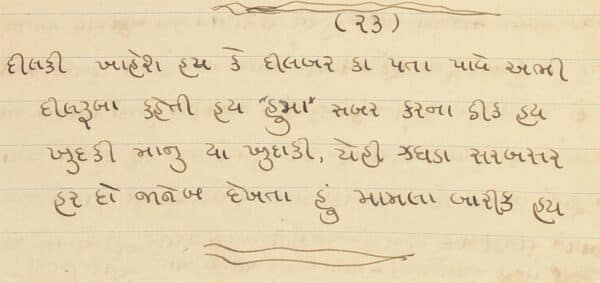
This verse-set from Huma was found in only one source, Khorshed’s songbook, bearing the number 23. The manuscript shows, as for most of Huma’s poems, a tick mark in pencil on the upper left above the first line. That’s all we know.
दिल की ख़्वाहिश है के दिलबर का पता पावे अभी
दिलरुबा कहती है “हुमा” सब्र करना ठीक है
ख़ुद की मानूँ या ख़ुदा की यही झगड़ा सर-बसर
हर दो जानिब देखता हूँ मामला बारीक है
My heart’s desire is news of my lover now!
My lover said, “Huma, patience is a virtue!”
To agree with myself or God, this is the whole debate.
I see both sides; it’s a subtle question.
Translated from Urdu by Carl W. Ernst.
Transcriptions and transliterations
Indian scripts transliteration table is available here.
 |
||
| Excerpt from the songbook of Khorshed K. Irani, showing the source of the lines presented here. Reproduced with permission of Asha and Sudam Wagh. |
Faithful transcription of the original Urdu-language poem (in Gujarātī script)
(૨૩)
દીલકી ખાહેશ હય કે દીલબર કા પતા પાવે અભી
દીલરૂબા કહેતી હય “હુમા” સબર કરના ઠીક હય
ખુદકી માનુ યા ખુદાકી, યેહી ઝઘડા સરબસર
હર દો જાનેબ દેખતા હું મામલા બારીક હય
Roman letter-for-letter transliteration of the original Urdu-language poem (in Gujarātī script)
(23)
dīlkī khāheś hay ke dīlbar kā patā pāve abhī
dīlrūbā kahetī hay “humā” sabar karnā ṭhīk hay
khudkī mānu yā khudākī, yehī jhaghḍā sarbasar
har do jāneb dekhtā huṁ māmlā bārīk hay
Devanāgarī letter-for-letter transliteration of the original Urdu-language poem (in Gujarātī script)
दीलकी खाहेश हय के दीलबर का पता पावे अभी
दीलरूबा कहेती हय “हुमा” सबर करना ठीक हय
खुदकी मानु या खुदाकी, येही झघडा सरबसर
हर दो जानेब देखता हुं मामला बारीक हय
Edited Devanāgarī transliteration
दिल की ख़्वाहिश है के दिलबर का पता पावे अभी
दिलरुबा कहती है “हुमा” सब्र करना ठीक है
ख़ुद की मानूँ या ख़ुदा की यही झगड़ा सर-बसर
हर दो जानिब देखता हूँ मामला बारीक है
Roman letter-for-letter transliteration of the edited Devanāgarī
dil kī ḳhvāhiś hai ke dilbar kā patā pāve abhī
dilrubā kahtī hai “humā” sabr karnā ṭhīk hai
ḳhud kī mānūm̐ yā ḳhudā kī yahī jhagṛā sar-basar
har do jānib dekhtā hūm̐ māmlā bārīk hai
Nastaʿlīq transliteration
دل کی خواہش ہے کہ دلبر کا پتا پاوے ابھی
دل ربا کہتی ہے هما صبر کرنا ٹھیک ہے
خود کی مانوں یا خدا کی یہی جھگڑا سر بسر
ہر دو جانب دیکھتا ہوں معاملہ باریک ہے
Type of composition and meter
The text is called a qitā or verse-set, it is not an entire ghazal.
If = means “long” and – means “short” the Urdu meter can be represented like this:
= – = = / = – = = / = – = = / = – = (prosodic feet terms: fāʿilātun fāʿilātun fāʿilun). The baḥr or meter is known as “ramal muṡamman maḥżūf”. Following the meter, one word would need to be moved around, and one word slightly modified, without altering the meaning.
dil kī ḳhvāhiś hai ke dilbar kā patā pāve abhī
dilrubā kahtī hai “humā” sabr karnā ṭhīk hai
ḳhud kī mānūm̐ yā ḳhudā kī ye hai jhagṛā sar-basar
har do jānib dekhtā hūm̐ māmlā bārīk hai
In order to respect the meter to the letter, one should actually say “‘humā’ hai”. But the meters have some flexibility and it would sound awkward.
Translations
English translation
My heart’s desire is news of my lover now!
My lover said, “Huma, patience is a virtue!”
To agree with myself or God, this is the whole debate.
I see both sides; it’s a subtle question.
Translated from Urdu by Carl W. Ernst
Notes on vocabulary and meaning
Although dilbar and dilrubā literally mean respectively, according to John T. Platts dictionary ((Platts, John T. (John Thompson). A dictionary of Urdu, classical Hindi, and English. London: W. H. Allen & Co., 1884.)) (p. 523), “heart-ravisher, a lovely person, a sweetheart” and “a charmer, sweetheart”, it is sometimes understood as the recipient of the love of the author in the ghazal universe, hence often rendered as the passive “beloved”. Here, “lover” was chosen in the English translation.
Explanation of the spelling edits
Most of the time, Khorshed used the common spelling used for Urdu, Arabo-Persian words, which differ slightly from Devanāgarī to reflect the differences in pronunciation. Gurajātī alphabet corresponds to Devanāgarī almost entirely. As in Devanāgarī, it lacks the possibility to transcribe all the Arabo-Persian consonants found in Urdu, but unlike Devanāgarī, the below dot is unused to mark ‘q’, ‘f’ and ‘z’.
Also, some Gurajātī grammatical and spelling practices were retained. Finally, Khorshed didn’t receive a high level or education and probably didn’t learn Urdu language, so, in some places, she may have misunderstood the meaning or not understood it at all.
dīlkī khāheś hay ke dīlbar kā patā pāve abhī
dīlrūbā kahetī hay “humā” sabar karnā ṭhīk hay
khudkī mānu yā khudākī, yehī jhaghaḍā sarbasar
har do jāneb dekhtā huṁ māmlā bārīk hay
- dīlkī Gurajātī script oftens uses a long vowel instead of a short one, hence dil was written dīl. This is the case here with rū in dīlrūbā as well. Following Gurajātī common practice, the postposition -kī was attached to the word, unlike the modern practice in Hindī. The same happens in the thirds line (khudkī, khudākī)
- khāheś Short “i” is often transcribed “e” yet pronounced as a short vowel. It is the case again here with ke and jāneb which stands for ki and jānib. We kept the spelling “ke” as this conjunction is often pronounced this way in Urdu.
- hay The diphtong “ai” is usually spelled “ay” in Khorshed’s songbook and other Gurajātī transcriptions
- kahetī Here, the schwa often pronounced before or after the sequence -aha- is written as “e”, unlike in Devanāgarī where it is left inherent to the consonant. The “e” in yehī follows the same rule and practice.
- sabar The separation of b and r is very common even in Hindi. We changed in to the standard sabr in order to follow the meter.
- huṁ The chandra bindu sign is not commonly used in Gurajātī script.